
- 1. 1. Understand Your Implantation Window (The Earliest Biologically Possible Timing)
- 2. Pregnancy Detection Timing — Using Ovulation Tests as Predictors
- 3. 2. Know When to Choose Blood Tests Over Urine Tests
- 4. 3. Use First-Morning Urine for Maximum Accuracy — Especially Early On
- 5. 4. Avoid Testing Immediately After Symptoms Appear
- 6. Pregnancy Detection Timing Mistakes That Lead to False Negatives
- 7. 5. Wait 48 Hours Between Tests for Meaningful Changes
- 1. ⭐ Final Thoughts
Pregnancy detection timing is one of the most misunderstood parts of early pregnancy. Many women rely solely on cycle predictions, ovulation apps, or symptoms that may not even be related to pregnancy. The truth is: when you test directly affects how accurate your result will be. Understanding timing strategies can save you days of anxiety, prevent false negatives, and give you the earliest, clearest answer possible.
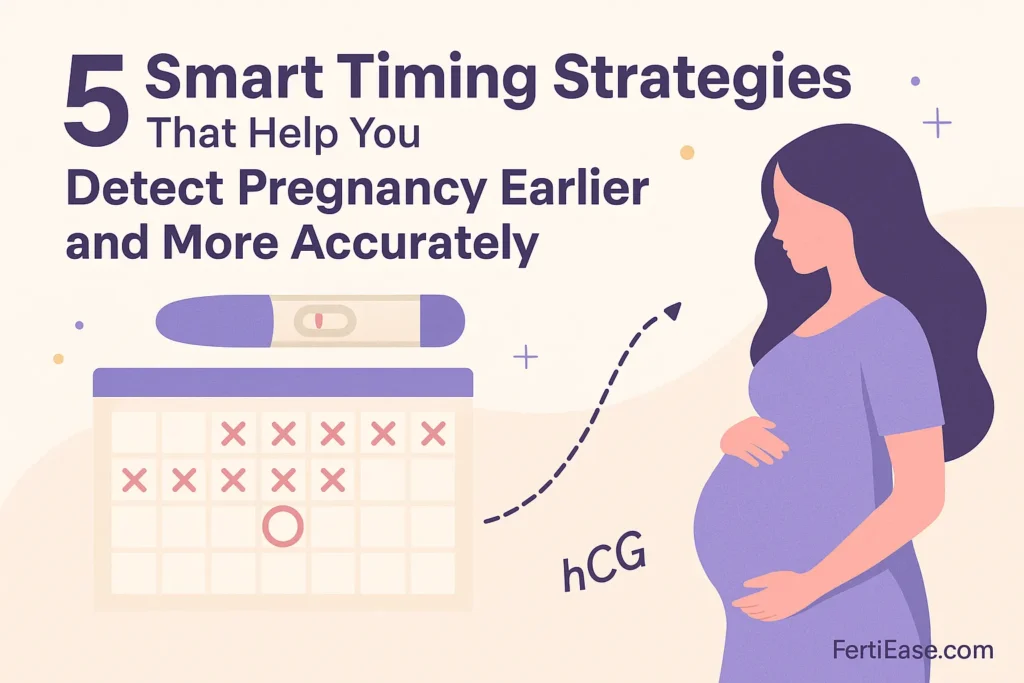
5 Smart Timing Strategies That Help You Detect Pregnancy Earlier And More Accurately Fertiease
This guide breaks down five evidence-based timing techniques that help detect pregnancy sooner — without wasting tests or getting misleading results. It builds upon ideas from our previous article, 6 Critical Early Pregnancy Signs That Tell You When to Take a Test, but introduces completely new timing strategies for even more accuracy.
1. Understand Your Implantation Window (The Earliest Biologically Possible Timing)
The single biggest factor in pregnancy test accuracy is understanding that implantation must occur before hCG appears in your urine or blood. Without implantation, no test — not even a blood test — can detect pregnancy.

Typical implantation timing:
Earliest: 6 days after ovulation
Most common: 8–10 days after ovulation
Latest normal range: 12 days after ovulation
Since hCG production only begins after implantation, testing earlier than 8–10 days past ovulation almost guarantees a false negative.
Mayo Clinic confirms this timing as the most reliable biological window for hormone detection.
Source: https://www.mayoclinic.org/
Pregnancy Detection Timing — Using Ovulation Tests as Predictors
If you’re trying to conceive, ovulation tests do more than help you plan intercourse — they also help you predict when to test for pregnancy.
Once you get a positive LH surge:
Ovulation typically occurs 24–36 hours later
Implantation can occur 6–12 days after ovulation
hCG becomes detectable 10–14 days after ovulation
This means the ideal test window is usually 12–14 days after a positive ovulation test.
Tracking LH helps eliminate guesswork, especially for women with irregular cycles who cannot rely on period dates alone.
2. Know When to Choose Blood Tests Over Urine Tests
Urine tests are convenient but limited in sensitivity. They usually detect hCG at 20–25 mIU/ml, while blood tests detect levels as low as 1 mIU/ml.
Choose a blood test if:
You suspect pregnancy but got multiple negative urine tests
You’re undergoing fertility treatment
You have a history of ectopic pregnancy
You want the earliest detection possible
Harvard Health points out that blood tests are essential for tracking early pregnancy progression, not just detection.
Source: https://www.health.harvard.edu/
3. Use First-Morning Urine for Maximum Accuracy — Especially Early On
The concentration of hCG in your urine is highest in the morning because you haven’t consumed fluids that dilute the hormone. This is especially important if:
You’re before or right at your expected period
You tend to drink lots of water
You have naturally dilute urine
You’re testing close to the earliest detection threshold
If you test later in the day, wait 3–4 hours without excessive drinking beforehand.
4. Avoid Testing Immediately After Symptoms Appear
Many women test the moment they feel nausea, breast tenderness, or mild cramping — but symptoms don’t always align with hCG detection.
Pregnancy-like symptoms that do not guarantee detectable hCG include:
PMS-related cramping
Progesterone-induced breast tenderness
Bloating
Fatigue
Headaches
These can appear before hCG reaches testable levels.
To avoid false negatives, wait at least 48 hours after your first noticeable symptom before testing.
Pregnancy Detection Timing Mistakes That Lead to False Negatives
Here are the most common timing errors that cause inaccurate results:
Testing before implantation has occurred
Miscalculating ovulation
Testing late at night
Drinking excessive water beforehand
Expecting symptoms to match hCG rise
Assuming all pregnancies produce hCG at the same rate
NIH data shows that hCG doubling rates vary widely between individuals, which is why timing matters more than symptoms.
Source: https://www.nih.gov/
5. Wait 48 Hours Between Tests for Meaningful Changes
If your first test is negative but pregnancy is still possible, waiting 48 hours is the most scientifically reliable approach.
Why 48 hours?
hCG typically doubles every 48–72 hours
A negative can turn positive within this timeframe
Faint lines often strengthen dramatically in 2 days
This prevents wasted tests and helps you see real hormonal progression, not random fluctuations.
For early physical signs that indicate it’s time to test, read:
👉 6 Critical Early Pregnancy Signs That Tell You When to Take a Test
⭐ Final Thoughts
Accurate pregnancy detection isn’t luck — it’s timing. Understanding implantation windows, LH surge timing, hCG behavior, and testing best practices empowers you to test confidently and avoid misleading results. Whether you’re trying to conceive or monitoring a potential early pregnancy, these strategies give you clarity and reliability every step of the way.
What is your reaction to this article?

Penelope Smith is a certified fertility wellness coach and passionate advocate for natural conception with over 8 years of experience guiding couples on their TTC journeys. Drawing from her background in holistic nutrition and reproductive health counseling, she empowers women and men through evidence-based strategies, compassionate support, and practical lifestyle insights. A mother of two conceived naturally after her own fertility challenges, Penelope blends science, empathy, and real-world results in her writing. Her articles have helped thousands optimize ovulation, balance hormones, and embrace the emotional side of trying to conceive. Connect with her at hello@fertiease.com
VIEW AUTHOR PROFILE