
- 1. 1. Implantation Cramping (6–12 Days After Ovulation)
- 2. Early Pregnancy Cramping Caused by Hormones
- 3. 2. Progesterone-Related Cramping
- 4. 3. Uterine Stretching & Expansion
- 5. 4. Increased Blood Flow to the Uterus
- 6. 5. Round Ligament Sensitivity
- 7. Early Pregnancy Cramping That Mimics PMS
- 8. 6. PMS-Like Mild Cramps Before Missed Period
- 9. 7. Gas & Bloating Related Cramps
- 10. 8. Cramping Triggered by Dehydration
- 11. 9. Early Pregnancy Constipation Cramps
- 12. 10. Light Exercise or Movement Cramping
- 13. 11. When Cramping Is Not Normal (Red Flags)
- 1. 🔗 External Medical Sources
- 1.0.0.1. 🔗 Internal Link
- 1.0.0.2. ⭐ Final Thoughts
Early pregnancy cramping is one of the most confusing and commonly misunderstood symptoms. Many women feel light cramps before a missed period and immediately wonder whether they’re experiencing implantation, early pregnancy changes, or just PMS. The truth is: mild cramping can absolutely be a normal sign of early pregnancy — but certain patterns can also signal when it’s time to contact a healthcare provider.
Throughout early pregnancy, your uterus prepares for implantation, increased blood flow, and rapid hormonal shifts. These changes create sensations that can feel similar to menstrual cramps, making it difficult to interpret what’s normal and what isn’t.
This guide explores 11 early pregnancy cramping signs, what causes them, when they’re harmless, and when they require attention. It pairs perfectly with our popular article, 12 Unexpected Early Pregnancy Symptoms Most Women Miss.

1. Implantation Cramping (6–12 Days After Ovulation)
Implantation occurs when the fertilized egg attaches itself to the uterine lining.
Cramps during this time usually feel like:
Light pulling
Mild pinching
Tingling or fluttering
Low abdominal warmth
They last from a few minutes to 48 hours.
Implantation may also be accompanied by a small amount of pink or brown spotting.
Early Pregnancy Cramping Caused by Hormones

11 Early Pregnancy Cramping Signs Whats Normal And Whats Not Fertiease
2. Progesterone-Related Cramping
Progesterone increases dramatically after conception, relaxing muscles and slowing digestion.
This hormone can cause:
Mild lower abdominal pressure
Sensation of fullness
Temporary tightening feelings
These are completely normal.
3. Uterine Stretching & Expansion
The uterus begins to expand surprisingly early in pregnancy.
This stretching may feel like:
Gentle tugging
PMS-like cramps
Low back pressure
Most women feel this as early as week 4–6.
4. Increased Blood Flow to the Uterus
Your body sends more blood to the uterus to support implantation and embryo development.
This increased circulation can create warmth, fullness, or mild cramp-like sensations.
5. Round Ligament Sensitivity
Although round ligament pain is more common in the second trimester, some women experience early ligament stretching.
It may feel like:
Sharp but brief twinges
Cramp-like pulls when moving
Sensitivity when standing quickly
Early Pregnancy Cramping That Mimics PMS
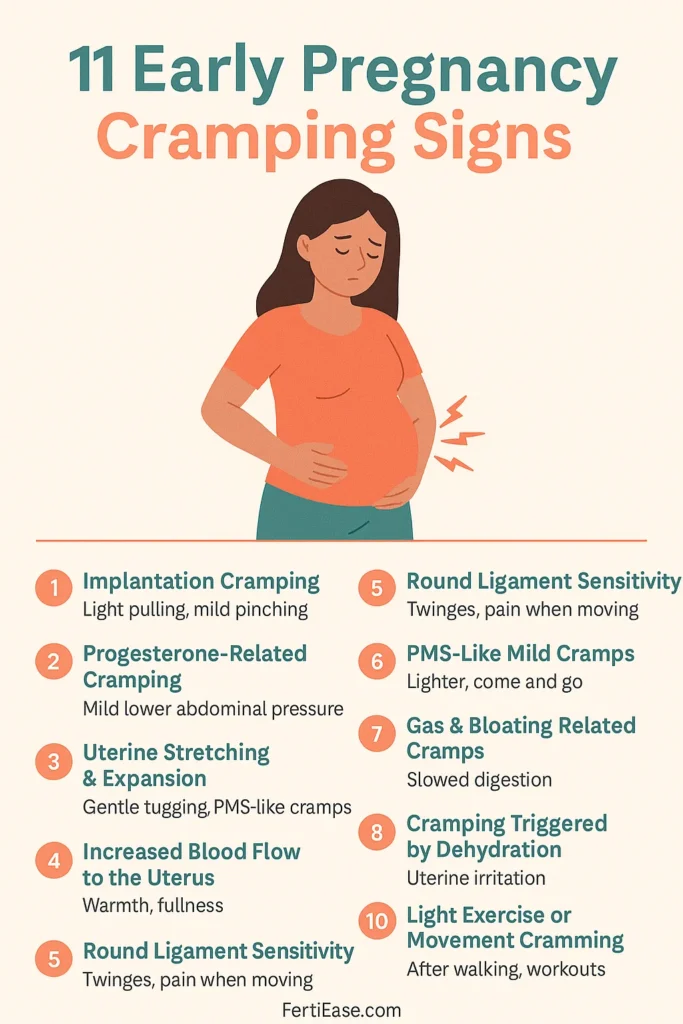
11 Early Pregnancy Cramping Signs Whats Normal And Whats Not 2 Fertiease
6. PMS-Like Mild Cramps Before Missed Period
One of the biggest TTC confusions is that pregnancy cramps often feel identical to PMS.
Key differences:
PMS cramps:
Stronger
Often radiate to the back
Consistent pattern
Early pregnancy cramps:
Lighter
Come and go
Usually lower in the pelvis
7. Gas & Bloating Related Cramps
Progesterone slows digestion, which creates more:
Gas
Bloating
Fullness
Slow bowel movements
This can trigger cramping that feels unrelated to the reproductive system but is still hormone-induced.
8. Cramping Triggered by Dehydration
Even mild dehydration can cause uterine irritation.
Pregnancy increases fluid needs — so cramps can occur simply because hydration isn’t keeping up.
9. Early Pregnancy Constipation Cramps
Progesterone softens smooth muscle tissue, slowing the digestive tract.
Constipation may cause:
Lower abdominal cramps
Sharp discomfort
Heaviness in the pelvic area
This is common in weeks 4–10.
10. Light Exercise or Movement Cramping
Some women experience mild cramps after activities such as:
Walking
Light workouts
Sexual activity
Stretching
These usually resolve on their own and are not harmful.
11. When Cramping Is Not Normal (Red Flags)
While mild cramping is typically harmless, certain symptoms indicate the need for medical attention:
❌ Severe or persistent pain
❌ Pain only on one side
❌ Heavy vaginal bleeding
❌ Shoulder pain
❌ Fever, chills, or dizziness
Possible concerns:
Ectopic pregnancy
Miscarriage
Ovarian cyst complications
Infection
Always contact a healthcare provider if something feels concerning.
🔗 External Medical Sources
Cleveland Clinic — Implantation & Cramping
NHS — Signs to Watch During Early Pregnancy
🔗 Internal Link
For more early pregnancy awareness, read:
👉 12 Unexpected Early Pregnancy Symptoms Most Women Miss
⭐ Final Thoughts
Cramping in early pregnancy is extremely common — and in most cases, completely normal. Understanding the difference between harmless signs (implantation, stretching, hormonal changes) and warning signs helps reduce stress and builds reproductive awareness. Every body reacts differently, but being informed allows you to navigate early pregnancy with confidence.
What is your reaction to this article?

Here is a professional English bio for Dr. Elizabeth Williams, Obstetrician-Gynecologist: Dr. Elizabeth Williams, MD, FACOG, is a board-certified obstetrician-gynecologist with over 15 years of experience providing compassionate, evidence-based women’s healthcare. She earned her medical degree from Johns Hopkins University School of Medicine and completed her residency in Obstetrics and Gynecology at Massachusetts General Hospital, Harvard Medical School, where she served as Chief Resident. Dr. Williams specializes in high-risk pregnancies, minimally invasive gynecologic surgery, adolescent gynecology, and menopause management. Known for her warm bedside manner and clear communication, she is dedicated to empowering her patients through every stage of life, from prenatal care and childbirth to preventive wellness and complex gynecologic conditions. In addition to her clinical practice, Dr. Williams is actively involved in medical education and has published research on preeclampsia, labor induction, and robotic-assisted surgery. She is a Fellow of the American College of Obstetricians and Gynecologists (FACOG) and a member of the Society for Maternal-Fetal Medicine. Patients describe Dr. Williams as “attentive, knowledgeable, and truly caring,” and she is proud to deliver hundreds of babies each year while building long-term relationships with the families she serves. Dr. Williams practices in [City/State] and is affiliated with [Hospital Name]. She welcomes new patients and offers both in-person and telemedicine appointments.
VIEW AUTHOR PROFILE