
- 1. Understanding DPO (Days Past Ovulation)
- 2. Very Early Pregnancy Symptoms After Ovulation — DPO Timeline
- 3. 1. 2–4 DPO: Mild Fatigue & Warm Body Temperature
- 4. 2. 5 DPO: Heightened Sense of Smell
- 5. 3. 6 DPO: Gentle Twinges or Implantation Prep Sensations
- 6. 4. 7 DPO: Possible Implantation Cramping
- 7. Very Early Pregnancy Symptoms After Ovulation — Hormonal Effects
- 8. 5. 8 DPO: Increased Hunger or Sudden Food Aversions
- 9. 6. 9 DPO: Unusual Fatigue
- 10. 7. 10 DPO: Breast Changes & Tingling
- 11. 8. 11 DPO: Emotional Sensitivity or Mood Shifts
- 12. 9. 12 DPO: Light Nausea or Digestive Changes
- 13. 10. 13–14 DPO: Bloating, Cramping & “Period-Like But Not PMS” Feelings
- 13.0.1. 🔗 Medical External Sources
- 13.0.2. 🔗 Internal Link
- 13.0.3. ⭐ Final Thoughts
Very early pregnancy symptoms after ovulation are often subtle, easily confused with PMS, and highly misunderstood — yet for many women, these tiny changes become the first clues of conception. After ovulation, your hormonal environment shifts dramatically, and if fertilization occurs, the body begins preparing for implantation even before a missed period or positive pregnancy test.
This guide breaks down a day-by-day DPO timeline, explaining what many women report feeling at 3 DPO, 5 DPO, 7 DPO, and beyond. While every pregnancy is unique, understanding these common patterns can help you interpret your symptoms during the two-week wait (TWW).
This article pairs perfectly with our previous guide, 12 Unexpected Early Pregnancy Symptoms Most Women Miss, offering a deeper look into conception timing.
Understanding DPO (Days Past Ovulation)
DPO simply means “days past ovulation.”
Most pregnancy symptoms occur due to:
Progesterone rising
Estrogen fluctuations
hCG increasing after implantation
Since implantation usually happens between 6–12 DPO, early symptoms often begin around this window.
Very Early Pregnancy Symptoms After Ovulation — DPO Timeline
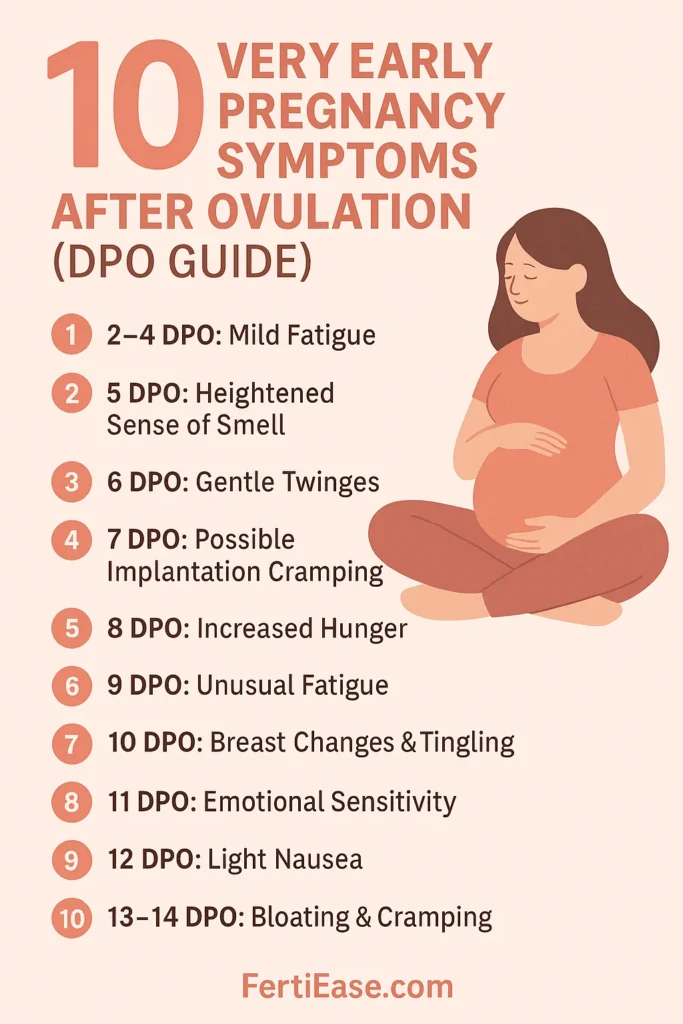
10 Very Early Pregnancy Symptoms After Ovulation DPO Timeline Explained 2 Fertiease
1. 2–4 DPO: Mild Fatigue & Warm Body Temperature
Although too early for implantation, many women notice hormonal changes right after ovulation.
Common sensations:
Feeling unusually warm
Higher nighttime temperature
Mild fatigue
Light lower abdominal heaviness
These symptoms are tied to progesterone, not pregnancy itself — but they lay the groundwork for early changes.
2. 5 DPO: Heightened Sense of Smell
Some women report a sudden sensitivity to odors around 5 DPO, even before implantation.
This happens because progesterone and estrogen fluctuate after ovulation.
You may notice strong reactions to:
Perfumes
Food smells
Cleaning products
Coffee
While not a confirmation, it can be an early clue.
3. 6 DPO: Gentle Twinges or Implantation Prep Sensations
True implantation generally hasn’t happened yet — but the uterus is preparing.
Some women describe:
Light twinges
Tiny pokes
Flutter-like sensations
These aren’t painful and usually last a few seconds to a few minutes.
4. 7 DPO: Possible Implantation Cramping
This is one of the earliest possible days for implantation.
Cramping at 7 DPO may feel like:
Light pulling
Mild PMS-like cramps
Warm pressure
Some women also notice very light spotting (pink or brown).
Very Early Pregnancy Symptoms After Ovulation — Hormonal Effects

10 Very Early Pregnancy Symptoms After Ovulation DPO Timeline Explained 3 Fertiease
5. 8 DPO: Increased Hunger or Sudden Food Aversions
After implantation begins, hCG rises — which affects appetite.
Some women feel:
Increased hunger
Random cravings
Instant aversions to certain foods
This symptom often intensifies around 10–12 DPO.
6. 9 DPO: Unusual Fatigue
Early pregnancy fatigue is deeper and heavier than PMS tiredness.
You may feel:
Sleepy throughout the day
Drained even after resting
Low energy unexpectedly
This is caused by rising progesterone and increased blood production.
7. 10 DPO: Breast Changes & Tingling
Breast sensitivity may show up early due to estrogen surges.
Common changes:
Tingling
Heaviness
Fuller appearance
Tender nipples
Some women also notice areola darkening.
8. 11 DPO: Emotional Sensitivity or Mood Shifts
Not all symptoms are physical.
Many women experience:
Irritability
Sudden crying
Feeling overwhelmed
Random emotional spikes
This is an early response to hCG interacting with neurotransmitters.
9. 12 DPO: Light Nausea or Digestive Changes
Although classic morning sickness usually appears around week 6, some women experience:
Mild queasiness
Sensitivity to certain smells
Bloated stomach
Metallic taste
This often occurs as hCG levels begin rising.
10. 13–14 DPO: Bloating, Cramping & “Period-Like But Not PMS” Feelings
Right before a missed period, cramping may return — but pregnancy cramps tend to be:
Lighter
Shorter
Lower in the pelvis
Less painful than PMS
If your period doesn’t arrive at 14 DPO, testing is recommended.
🔗 Medical External Sources
🔗 Internal Link
For more insight into symptoms during early pregnancy, read:
👉 12 Unexpected Early Pregnancy Symptoms Most Women Miss
⭐ Final Thoughts
Every body experiences the early stages of pregnancy differently, but the DPO timeline reveals fascinating hormonal patterns that many women share. Whether you’re TTC or just learning about reproductive wellness, recognizing these very early pregnancy symptoms after ovulation can provide clarity and emotional support during the two-week wait.
Patience, awareness, and consistency make this journey more manageable — and knowledge is one of the most powerful tools.
What is your reaction to this article?

Here is a professional English bio for Dr. Elizabeth Williams, Obstetrician-Gynecologist: Dr. Elizabeth Williams, MD, FACOG, is a board-certified obstetrician-gynecologist with over 15 years of experience providing compassionate, evidence-based women’s healthcare. She earned her medical degree from Johns Hopkins University School of Medicine and completed her residency in Obstetrics and Gynecology at Massachusetts General Hospital, Harvard Medical School, where she served as Chief Resident. Dr. Williams specializes in high-risk pregnancies, minimally invasive gynecologic surgery, adolescent gynecology, and menopause management. Known for her warm bedside manner and clear communication, she is dedicated to empowering her patients through every stage of life, from prenatal care and childbirth to preventive wellness and complex gynecologic conditions. In addition to her clinical practice, Dr. Williams is actively involved in medical education and has published research on preeclampsia, labor induction, and robotic-assisted surgery. She is a Fellow of the American College of Obstetricians and Gynecologists (FACOG) and a member of the Society for Maternal-Fetal Medicine. Patients describe Dr. Williams as “attentive, knowledgeable, and truly caring,” and she is proud to deliver hundreds of babies each year while building long-term relationships with the families she serves. Dr. Williams practices in [City/State] and is affiliated with [Hospital Name]. She welcomes new patients and offers both in-person and telemedicine appointments.
VIEW AUTHOR PROFILE