
- 1. How Long Does It Take to Get Pregnant? A Clear, Science-Based Timeline
- 2. How Long Does It Typically Take?
- 3. The Role of Timing: Why Ovulation Matters Most
- 4. Age and Fertility: What Changes?
- 4.1. Under 35
- 4.2. Ages 35–39
- 4.3. 40+
- 5. How Many Tries Does It Actually Take Per Cycle?
- 6. When Should You See a Doctor?
- 7. Bottom Line
How Long Does It Take to Get Pregnant? A Clear, Science-Based Timeline
If you’re trying to conceive, one of the first questions you’ll wonder is: “How long does it normally take to get pregnant?”
The truth is, even for completely healthy couples, pregnancy doesn’t always happen immediately. Understanding the natural timeline can ease anxiety and help you make sense of your cycle, your fertility window, and what’s normal.
Below is a clear, research-backed breakdown based on major medical organizations like the American College of Obstetricians and Gynecologists (ACOG) and the Centers for Disease Control and Prevention (CDC).

How Long Does It Typically Take?
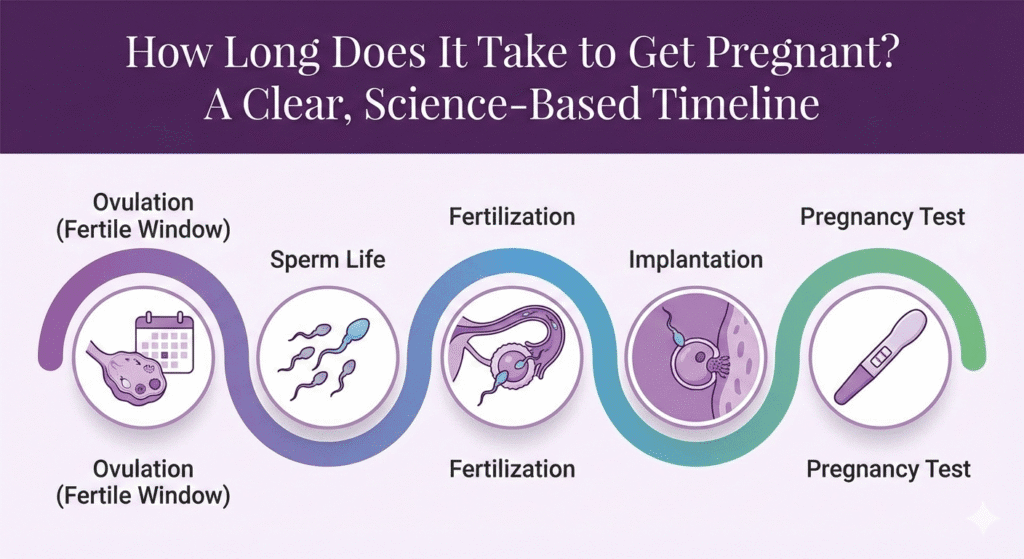
According to ACOG, about:
30% of couples conceive within the first month
60% within 3 months
80% within 6 months
85% within 12 months
This means it can take up to one full year for most healthy couples to get pregnant—even when timing sex correctly.
This timeline assumes both partners are in good health and the woman is under age 35.
The Role of Timing: Why Ovulation Matters Most
Pregnancy is most likely to occur when sex happens in the 5 days leading up to ovulation and on ovulation day.
The fertile window is usually:
Cycle Day 10–14 (for a 28-day cycle)
Earlier for shorter cycles
Later for longer cycles
Studies referenced by the National Institutes of Health (NIH) confirm that timing intercourse during this window dramatically increases the chances of conceiving.
Age and Fertility: What Changes?
Age plays a major role in how long it may take:
Under 35
Most conceive within 12 months.
Ages 35–39
Fertility begins to decline; ACOG recommends seeking help if pregnancy hasn’t occurred after 6 months.
40+
Conception is still possible, but egg quantity and quality decrease significantly. Medical guidance is recommended earlier.
How Many Tries Does It Actually Take Per Cycle?
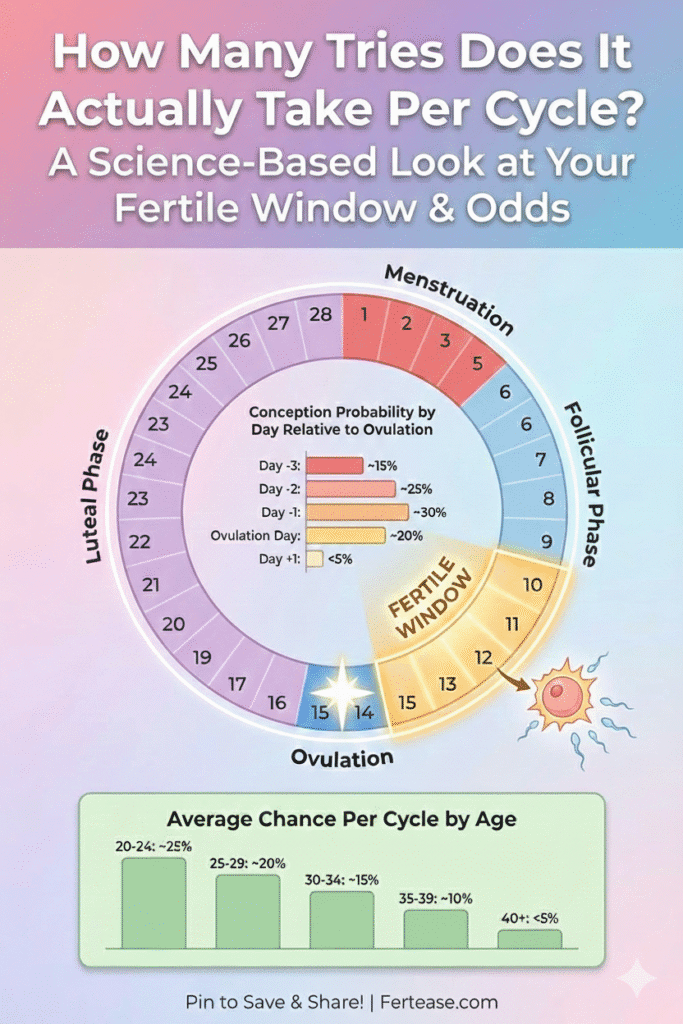
Each cycle has a 15–25% chance of conception for a healthy couple (ACOG).
This means even perfect timing doesn’t guarantee pregnancy every month.
Ovulation can shift due to:
stress
illness
travel
hormonal fluctuations
disrupted sleep patterns
Tracking ovulation (your earlier article!) can help optimize timing.
When Should You See a Doctor?
ACOG and CDC recommend evaluation if:
Under 35: No pregnancy after 12 months of trying
35 and older: No pregnancy after 6 months
40 and older: Seek guidance right away
Also consult a doctor sooner if you have:
irregular cycles
known reproductive health issues
severe period pain
thyroid problems
prior pelvic infections
Bottom Line
Getting pregnant takes time—even for healthy couples. Most conceive within a year, and many within just a few months. Understanding your fertile window, tracking your cycle, and maintaining overall health can improve your chances. If you’re trying and feeling uncertain, you’re not alone. A supportive provider can help guide you through the journey.
What is your reaction to this article?

Here is a professional English bio for Dr. Elizabeth Williams, Obstetrician-Gynecologist: Dr. Elizabeth Williams, MD, FACOG, is a board-certified obstetrician-gynecologist with over 15 years of experience providing compassionate, evidence-based women’s healthcare. She earned her medical degree from Johns Hopkins University School of Medicine and completed her residency in Obstetrics and Gynecology at Massachusetts General Hospital, Harvard Medical School, where she served as Chief Resident. Dr. Williams specializes in high-risk pregnancies, minimally invasive gynecologic surgery, adolescent gynecology, and menopause management. Known for her warm bedside manner and clear communication, she is dedicated to empowering her patients through every stage of life, from prenatal care and childbirth to preventive wellness and complex gynecologic conditions. In addition to her clinical practice, Dr. Williams is actively involved in medical education and has published research on preeclampsia, labor induction, and robotic-assisted surgery. She is a Fellow of the American College of Obstetricians and Gynecologists (FACOG) and a member of the Society for Maternal-Fetal Medicine. Patients describe Dr. Williams as “attentive, knowledgeable, and truly caring,” and she is proud to deliver hundreds of babies each year while building long-term relationships with the families she serves. Dr. Williams practices in [City/State] and is affiliated with [Hospital Name]. She welcomes new patients and offers both in-person and telemedicine appointments.
VIEW AUTHOR PROFILE