
- 1. 🌱 Why Supplements Matter for Fertility
- 2. 🧠 How We Evaluated These Supplements
- 3. 🏆 12 Best Fertility Supplements for Women (Expert Picks)
- 3.1. 1️⃣ Prenatal Multivitamin with Folate
- 3.2. 2️⃣ Vitamin D3
- 3.3. 3️⃣ Omega-3 (DHA + EPA)
- 3.4. 4️⃣ Coenzyme Q10 (CoQ10)
- 3.5. 5️⃣ Myo-Inositol
- 3.6. 6️⃣ Iron (if deficient)
- 3.7. 7️⃣ Zinc
- 3.8. 8️⃣ Selenium
- 3.9. 9️⃣ Vitamin E
- 3.10. 🔟 Probiotics
- 3.11. 1️⃣1️⃣ L-Arginine
- 3.12. 1️⃣2️⃣ Chasteberry (Vitex)
- 4. 🧠 Supplements to Approach With Caution
- 5. 🔍 Best Fertility Supplements for Women — By Goal
- 6. 🧪 When to Start Taking Fertility Supplements
- 7. 🩺 Safety & Best Practices
- 8. 🧠 Final Thoughts
Trying to conceive (TTC) is a journey filled with anticipation, hope, and questions. One of the most common questions women ask is: “Which supplements actually support fertility?”
With so many options online, it’s easy to feel overwhelmed. The good news? Some supplements are backed by science and may support key reproductive functions—especially when paired with a balanced diet and healthy lifestyle.
In this guide, you’ll discover the best fertility supplements for women, what they do, how they work, and how to choose them safely.

Best Fertility Supplements For Women 12 Doctor Backed Picks What Science Says 2 Fertiease
🌱 Why Supplements Matter for Fertility
Supplements are not magic pills—but they can help fill nutritional gaps, support hormone balance, and optimize reproductive health.
They’re especially useful if:
You have irregular cycles
You’re deficient in key nutrients
You’re over age 30
You’re planning IVF or fertility treatments
You want to optimize egg quality
Before starting any supplement, talk to your healthcare provider—especially if you have medical conditions or take medications.
🧠 How We Evaluated These Supplements
To choose the best fertility supplements for women, we looked for:
✔️ Human studies (not just animal data)
✔️ Hormone and reproductive system relevance
✔️ Safety during preconception & early pregnancy
✔️ Common clinical use
🏆 12 Best Fertility Supplements for Women (Expert Picks)
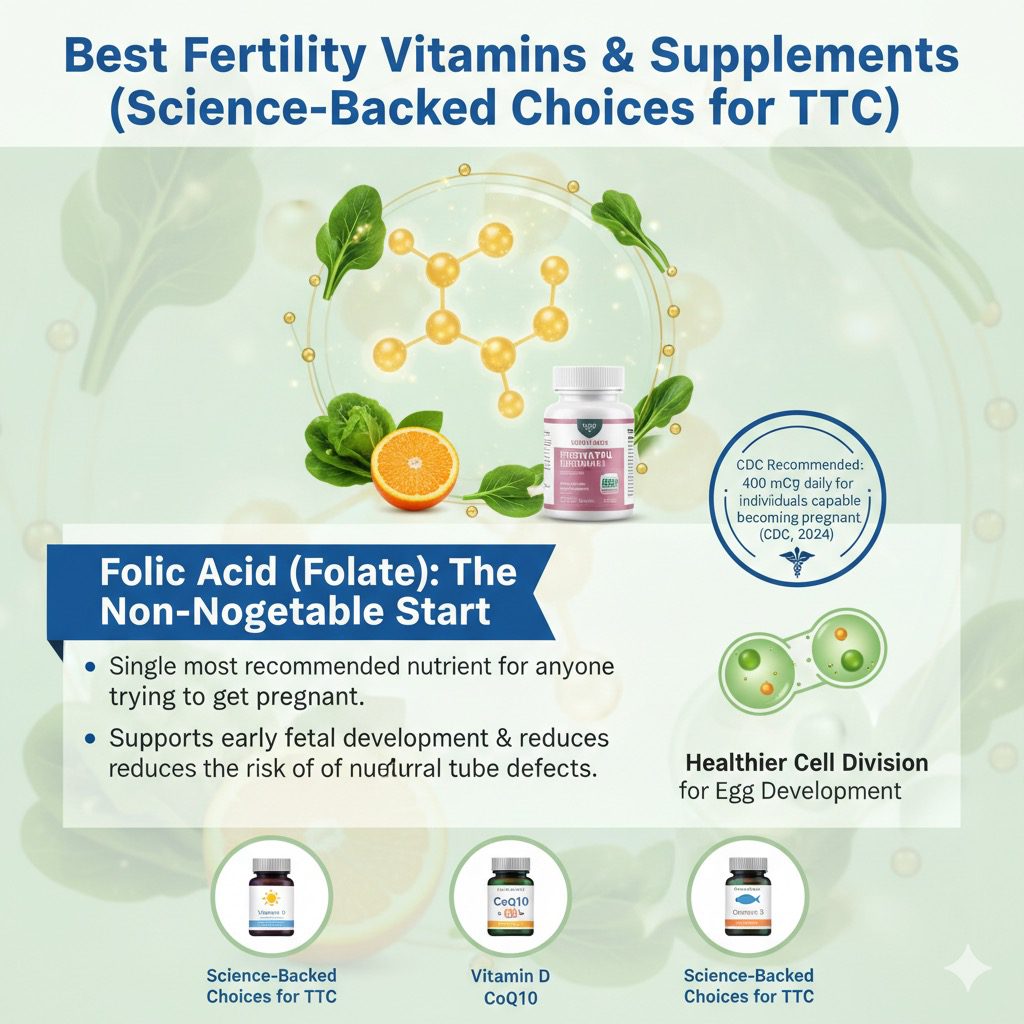
1️⃣ Prenatal Multivitamin with Folate
Why it’s first: Most prenatal multivitamins provide a strong foundation.
Key benefits:
Folate (or methylated folate) supports neural tube development
Iron helps prevent early pregnancy anemia
B vitamins support energy metabolism
🧠 Folate before conception reduces neural tube defect risk.
💡 Tip: Choose folate over folic acid (especially MTHFR variants).
2️⃣ Vitamin D3
Low vitamin D levels are extremely common and may relate to fertility challenges.
Benefits:
Supports hormone balance
May help regulate menstrual cycles
Linked to improved IVF outcomes
Fun fact: Vitamin D acts like a hormone, not just a vitamin.
3️⃣ Omega-3 (DHA + EPA)
Essential fatty acids aren’t just for baby brain—they’re critical for fertility too.
Benefits:
Supports healthy ovulation
Reduces inflammation
Supports egg quality and implantation
Helps mood regulation during TTC
Plant sources (ALA) are okay—but fish oil DHA/EPA is more directly usable by the body.
4️⃣ Coenzyme Q10 (CoQ10)
A favorite in fertility clinics, especially for women 30+.
Benefits:
Cellular energy production
May improve egg mitochondrial function
Linked to improved ovarian response
Advanced tip: Ubiquinol form is often more bioavailable for older women.
5️⃣ Myo-Inositol
A key supplement for women with PCOS or insulin resistance.
Benefits:
Helps balance insulin sensitivity
Supports ovulation
Improves egg quality
Often used with D-Chiro Inositol in a 40:1 ratio for best results.
6️⃣ Iron (if deficient)
Iron deficiency can affect ovulation and early pregnancy energy.
Benefits:
Supports healthy blood volume
Reduces fatigue
Aids fetal development after conception
Get your levels tested; unnecessary iron can be harmful.
7️⃣ Zinc
A trace mineral with big fertility impact.
Benefits:
Supports hormone production
Helps ovulation
Supports cell division post-fertilization
Zinc is often overlooked but essential.
8️⃣ Selenium
Another trace mineral with reproductive importance.
Benefits:
Antioxidant support
Supports thyroid function (TTC + pregnancy)
Thyroid health and fertility are closely linked—selenium helps both.
9️⃣ Vitamin E
Fat-soluble antioxidant that may support egg quality and progesterone production.
Benefits:
Antioxidant protection
Supports blood flow
Helps hormone receptors
Best taken with fats for absorption.
🔟 Probiotics
Your gut microbiome and reproductive hormones are linked.
Benefits:
Supports immune balance
May improve hormone signaling
Enhances nutrient absorption
Look for strains like Lactobacillus and Bifidobacterium.
1️⃣1️⃣ L-Arginine
An amino acid that supports blood flow.
Benefits:
May improve uterine and ovarian blood flow
Supports nitric oxide production
Use with care if you have migraines or estrogen sensitivity.
1️⃣2️⃣ Chasteberry (Vitex)
Plant extract used traditionally for hormonal balance.
Benefits:
May support progesterone balance
Helps regularize cycles
Not ideal for women with hormone-sensitive conditions (e.g., hormone-dependent cancers).
🧠 Supplements to Approach With Caution
❌ High-dose herbs without evidence
❌ Unregulated fertility blends with proprietary formulas
❌ Too much antioxidants (>100% RDA) without guidance
Supplements are supportive—not replacements for a balanced diet. Always check for purity and third-party testing.
Best Fertility Supplements For Women 12 Doctor Backed Picks What Science Says 3 Fertiease
🔍 Best Fertility Supplements for Women — By Goal
| Goal | Best Supplements |
|---|---|
| Ovulation support | Myo-Inositol, Zinc, Vitamin D |
| Egg quality | CoQ10, Omega-3, Vitamin E |
| Hormone balance | Vitex, Vitamin D, Zinc |
| Below-normal levels | Iron, Vitamin D, Probiotics |
| General TTC foundation | Prenatal Multivitamin, Omega-3, Probiotics |
🧪 When to Start Taking Fertility Supplements
Most experts recommend starting 3–6 months before TTC for optimal levels, especially for:
Folate
Vitamin D
CoQ10
Omega-3
This gives your body time to build nutrient stores.
🩺 Safety & Best Practices
✔️ Talk to your doctor before starting
✔️ Test vitamin D and iron levels before supplementing
✔️ Choose reputable brands (third-party tested)
✔️ Avoid excessive dosages
✔️ Pair supplements with whole foods for best results
Supplements are partners, not replacements, for nutrition.
🧠 Final Thoughts
Choosing the best fertility supplements for women doesn’t have to be overwhelming.
Focus on a foundation (prenatal + basic nutrients) first, then tailor additions based on your:
Age
Cycle patterns
Medical history
TTC journey
The right supplements can fill gaps, support hormones, and optimize your reproductive system—but they’re most effective when combined with:
✨ balanced diet
✨ stress management
✨ quality sleep
✨ regular movement
Your body deserves support—not shortcuts.
What is your reaction to this article?

Penelope Smith is a certified fertility wellness coach and passionate advocate for natural conception with over 8 years of experience guiding couples on their TTC journeys. Drawing from her background in holistic nutrition and reproductive health counseling, she empowers women and men through evidence-based strategies, compassionate support, and practical lifestyle insights. A mother of two conceived naturally after her own fertility challenges, Penelope blends science, empathy, and real-world results in her writing. Her articles have helped thousands optimize ovulation, balance hormones, and embrace the emotional side of trying to conceive. Connect with her at hello@fertiease.com
VIEW AUTHOR PROFILE