
- 1. 🌱 Why Planks Are So Popular (and So Confusing During Pregnancy)
- 2. 🤰 How Pregnancy Changes Your Core Muscles
- 3. ⚠️ When Planks Are NOT Safe During Pregnancy
- 4. ✅ When Planks MAY Be Safe During Pregnancy
- 5. 🕒 Planks by Trimester: What You Should Know
- 5.1. First Trimester
- 5.2. Second Trimester
- 5.3. Third Trimester
- 6. 💡 Signs You Should Stop Doing Planks Immediately
- 7. 💪 Safer Alternatives to Planks During Pregnancy
- 7.1. ✔️ Pregnancy-Safe Core Alternatives
- 8. 🧠 The Role of Breathing in Core Safety
- 9. 🧬 Medical Guidance on Planks During Pregnancy
- 10. 📌 Related Article
- 11. ✅ Final Thoughts
Many women who exercised regularly before pregnancy ask the same critical question: is plank safe during pregnancy? Planks are known as one of the most effective core exercises—but pregnancy changes how your core functions, how pressure is distributed, and how much stability your body can safely handle.
The short answer is: it depends.
In this article, you’ll learn when planks can be safe, when they should be avoided, how pregnancy affects your abdominal muscles, and what safer alternatives you can choose to protect both your body and your baby.

Is Plank Safe During Pregnancy 7 Powerful Facts Every Mom To Be Should Know 2 Fertiease
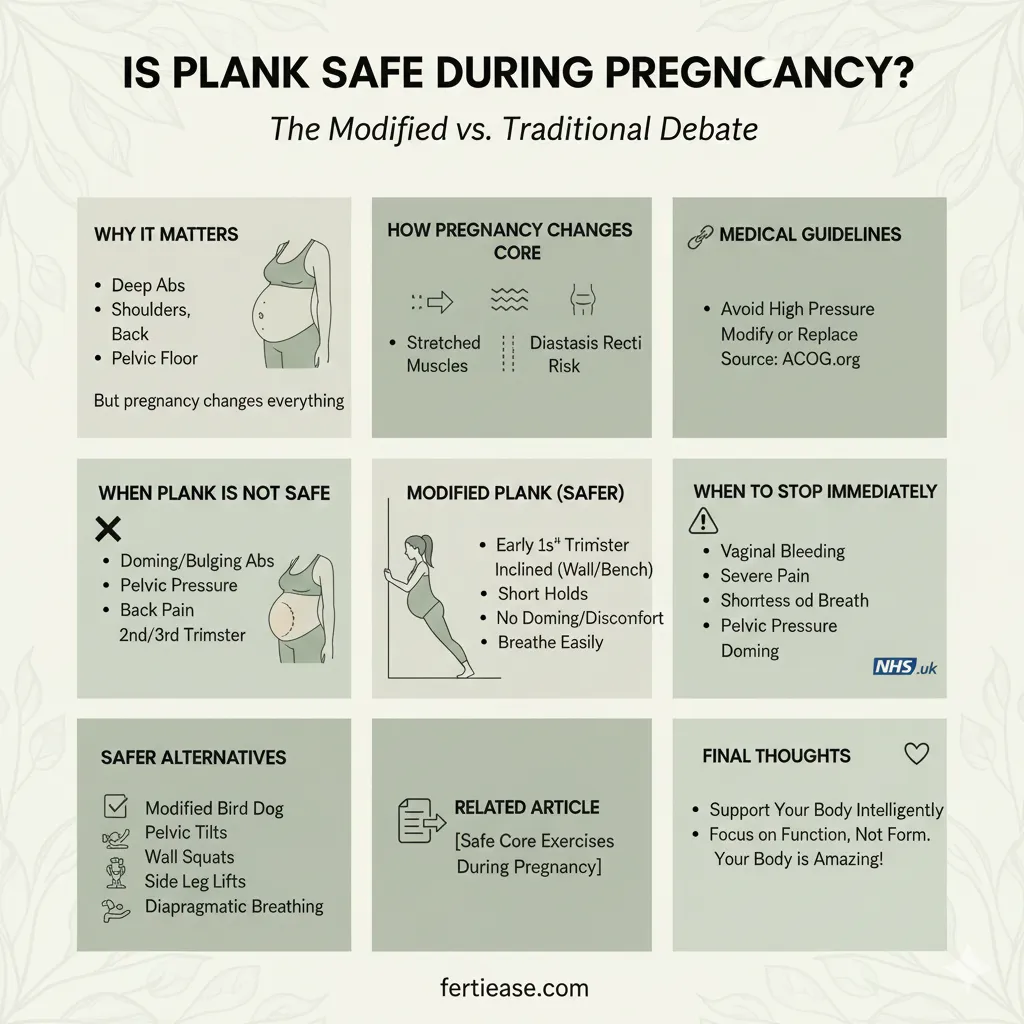
🌱 Why Planks Are So Popular (and So Confusing During Pregnancy)
Planks target:
Deep abdominal muscles
Shoulders and arms
Lower back
Pelvic floor (indirectly)
Before pregnancy, planks are considered a full-body stabilizing exercise. During pregnancy, however, the growing uterus and hormonal changes significantly alter how your core responds to pressure.
That’s why understanding whether planks are safe during pregnancy requires more than a yes-or-no answer.
🤰 How Pregnancy Changes Your Core Muscles
During pregnancy:
The uterus expands forward
The abdominal muscles stretch
The connective tissue (linea alba) softens
The pelvic floor carries increased load
This can lead to diastasis recti (abdominal separation) if excessive pressure is placed on the core.
Planks, if done incorrectly or for too long, can increase intra-abdominal pressure, which may:
Strain the pelvic floor
Worsen abdominal separation
Cause visible abdominal doming or coning
⚠️ When Planks Are NOT Safe During Pregnancy
For many women, traditional planks are not recommended, especially as pregnancy progresses.
Planks may be unsafe if you:
Notice abdominal doming or bulging
Feel pressure in the pelvis
Experience lower back pain during the exercise
Hold your breath while bracing
Are in the second or third trimester with a visible belly
In these cases, continuing planks may do more harm than good.
🔗 External reference:
https://www.acog.org
✅ When Planks MAY Be Safe During Pregnancy
Planks may be safe only under specific conditions.
You may be able to do modified planks if:
You are in the early first trimester
You had strong core control before pregnancy
You do not experience doming or discomfort
You can breathe comfortably during the exercise
Your healthcare provider has no restrictions
Even then, planks should be short, controlled, and modified.
🕒 Planks by Trimester: What You Should Know
First Trimester
In early pregnancy:
Some women can tolerate short, modified planks
Hormonal changes are already affecting connective tissue
If done, planks should be:
Inclined (hands on bench or wall)
Held for short durations
Closely monitored for form
Second Trimester
As the belly grows:
Core pressure increases
Abdominal separation risk rises
For most women, traditional planks should be avoided in this trimester. Modified versions may still be appropriate, but alternatives are often safer.
Third Trimester
In late pregnancy:
Planks are generally not recommended
Balance and pressure risks are higher
The focus should shift to breathing and mobility
At this stage, planks offer little benefit compared to safer core exercises.
💡 Signs You Should Stop Doing Planks Immediately
Stop planks if you notice:
Abdominal coning or doming
Pelvic heaviness or pressure
Shortness of breath
Lower back or wrist pain
Difficulty maintaining form
These signs indicate that your core is under too much strain.
💪 Safer Alternatives to Planks During Pregnancy
Instead of planks, choose exercises that support the core without excessive pressure.
✔️ Pregnancy-Safe Core Alternatives
Modified bird dog
Pelvic tilts
Seated core engagement
Wall-supported squats
Side-lying leg lifts
Diaphragmatic breathing
These exercises strengthen the core while protecting the abdominal wall and pelvic floor.
📌 Related article:
👉 [Safe Core Exercises During Pregnancy: 8 Powerful Moves to Protect Your Body]
🧠 The Role of Breathing in Core Safety
Breath-holding during planks is a major risk factor.
Pregnancy-safe core training should:
Emphasize slow, controlled breathing
Coordinate movement with exhalation
Avoid bracing or breath-holding
Breath-first core training is far more effective and safer than static holds like planks.
🧬 Medical Guidance on Planks During Pregnancy
Most medical and prenatal fitness guidelines suggest:
Avoiding exercises that significantly increase abdominal pressure
Modifying or replacing traditional planks
Focusing on functional strength and posture
🔗 External reference:
https://www.nhs.uk
📌 Related Article
👉 [Best Exercises During Pregnancy by Trimester: 9 Powerful Moves for a Healthy Body]
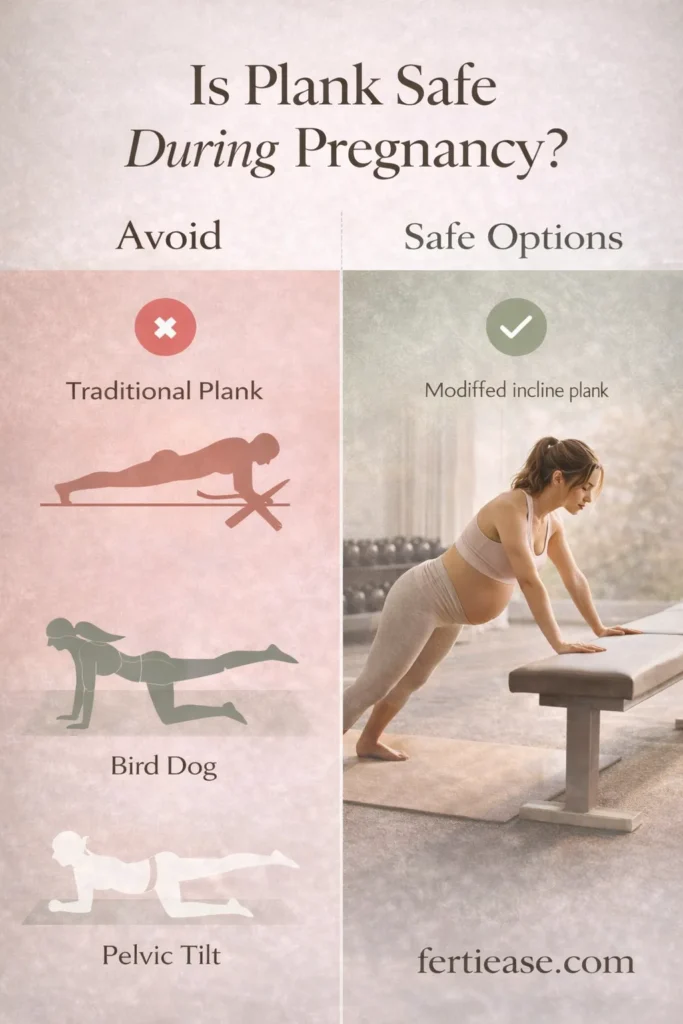
Is Plank Safe During Pregnancy 7 Powerful Facts Every Mom To Be Should Know 3 Fertiease
✅ Final Thoughts
So, is plank safe during pregnancy?
For most women, traditional planks are not the best choice, especially after the first trimester.
Pregnancy fitness is not about maintaining pre-pregnancy workouts—it’s about supporting your changing body intelligently. Safer core alternatives can provide all the benefits of planks without the risks.
Protect your core now, and your body will thank you during labor and recovery.
What is your reaction to this article?

Penelope Smith is a certified fertility wellness coach and passionate advocate for natural conception with over 8 years of experience guiding couples on their TTC journeys. Drawing from her background in holistic nutrition and reproductive health counseling, she empowers women and men through evidence-based strategies, compassionate support, and practical lifestyle insights. A mother of two conceived naturally after her own fertility challenges, Penelope blends science, empathy, and real-world results in her writing. Her articles have helped thousands optimize ovulation, balance hormones, and embrace the emotional side of trying to conceive. Connect with her at hello@fertiease.com
VIEW AUTHOR PROFILE